Why Is It in My Shampoo?
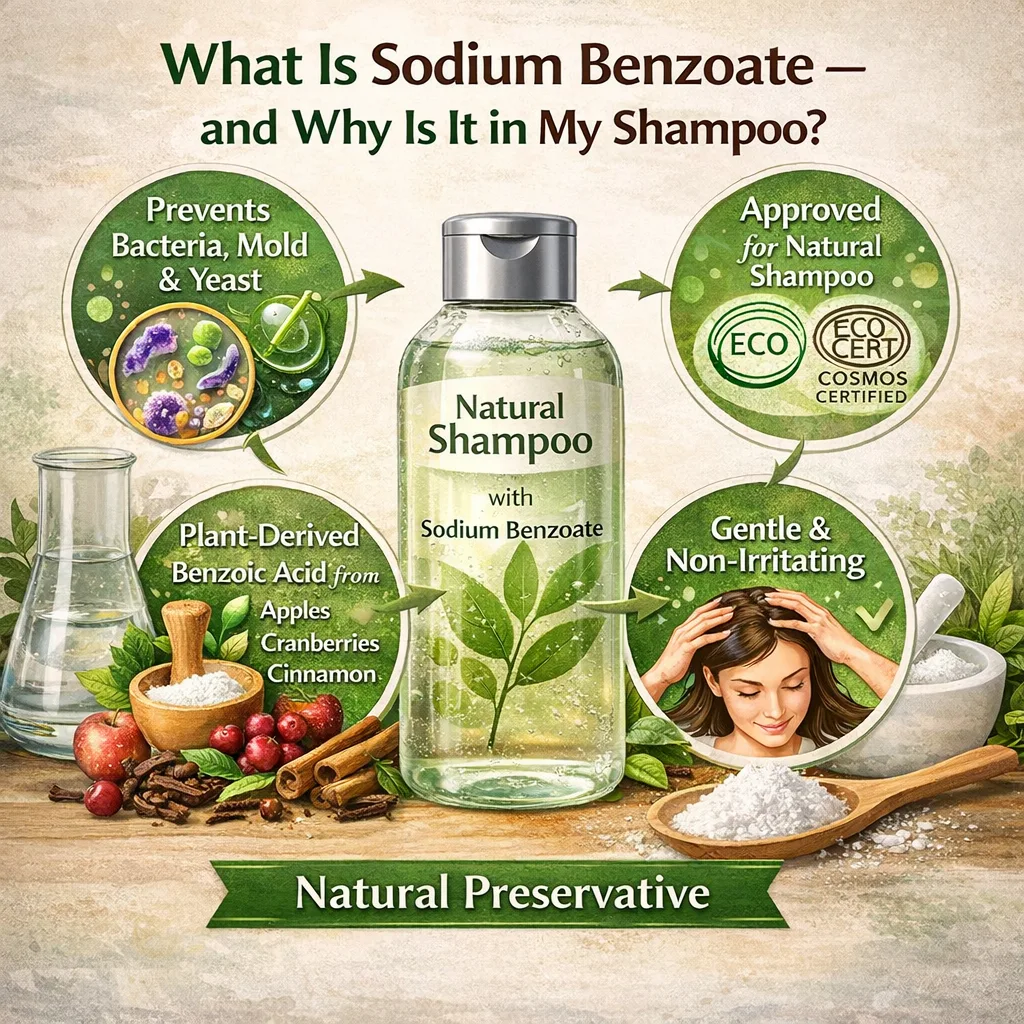
If you use natural or clean beauty shampoos, you may notice sodium benzoate on the ingredient label. Despite its chemical-sounding name, sodium benzoate is one of the most widely accepted preservatives in natural personal care—and for good reason.
This article explains what sodium benzoate is, why it’s used in shampoo, and why natural brands rely on it instead of harsher preservatives.
What Is Sodium Benzoate?
Sodium benzoate is the sodium salt of benzoic acid, a compound that occurs naturally in many plants and foods, including:
- Cranberries
- Cinnamon
- Apples
- Cloves
In cosmetics, sodium benzoate is used as a preservative to prevent the growth of:
- Bacteria
- Yeast
- Mold
It is water-soluble, odorless, and stable—making it ideal for liquid products like shampoo.
Is Sodium Benzoate “Natural”?
In the context of natural and clean beauty, sodium benzoate is considered nature-derived.
- Benzoic acid occurs naturally in plants
- Sodium benzoate is produced by neutralizing benzoic acid with sodium salts
- The final ingredient is chemically identical to its naturally occurring form
Because of this, sodium benzoate is:
- ECOCERT-approved
- COSMOS-approved
- Accepted by most clean beauty standards
This places it in the same category as other fermentation- or mineral-derived cosmetic ingredients.
Why Shampoo Needs a Preservative (Even Natural Shampoo)
Shampoo is primarily:
- Water
- Surfactants
- Plant extracts
This makes it a perfect environment for microbial growth.
Without a preservative, shampoo can quickly become contaminated with:
- Pathogenic bacteria
- Mold spores
- Yeast
Contaminated shampoo is not just ineffective—it can cause:
- Scalp irritation
- Folliculitis
- Eye infections
- Product spoilage within weeks
“Natural” does not mean self-preserving.
Why Sodium Benzoate Is Used in Natural Shampoo
1. Broad-Spectrum Microbial Protection
Sodium benzoate is particularly effective against:
- Yeast
- Mold
- Some bacteria
This makes it ideal for shampoos containing:
- Aloe vera
- Herbal extracts
- Botanical waters
It is commonly paired with potassium sorbate or gluconolactone to create a full-spectrum natural preservative system.
2. Gentle on Scalp and Hair
Compared to traditional preservatives, sodium benzoate is:
- Non-sensitizing
- Non-irritating at cosmetic concentrations
- Suitable for sensitive scalps and children
It does not strip oils, disrupt the scalp barrier, or cause buildup on hair.
3. Approved by Natural Certification Bodies
Natural brands choose sodium benzoate because it complies with:
- ECOCERT
- COSMOS
- Whole Foods Premium Body Care standards (legacy)
This allows brands to maintain clean-label credibility without compromising safety.
4. Effective at Low Concentrations
Typical shampoo usage rates:
- 0.25%–0.5%
At these levels, sodium benzoate:
- Does not affect scent
- Does not alter shampoo texture
- Does not dry hair or scalp
Sodium Benzoate vs. “Harsh” Preservatives
| Preservative | Common Concerns | Used in Natural Shampoo |
|---|---|---|
| Parabens | Endocrine concerns | No |
| Formaldehyde releasers | Skin irritation | No |
| Phenoxyethanol | Not ECOCERT | Limited |
| Sodium benzoate | Plant-derived, gentle | Yes |
Sodium benzoate is often chosen specifically to avoid parabens and formaldehyde donors.
Does Sodium Benzoate Cause Cancer or Hormone Issues?
No.
- Sodium benzoate has been extensively studied
- Approved globally for cosmetic and food use
- Considered low-risk and non-carcinogenic
Concerns often arise from confusion with unrelated industrial chemicals or misuse at non-cosmetic concentrations.
In properly formulated shampoo, sodium benzoate is well within safety margins.
Does Sodium Benzoate Dry Out Hair?
No.
Sodium benzoate:
- Does not evaporate
- Does not strip lipids
- Does not alter hair protein structure
Any dryness experienced from shampoo is typically due to:
- Surfactant choice
- Over-washing
- Lack of conditioning agents
Not the preservative system.
Why You’ll Keep Seeing Sodium Benzoate in Clean Shampoo
Natural shampoo brands face a real challenge:
- Avoid harsh preservatives
- Maintain product safety
- Achieve shelf stability
- Meet certification standards
Sodium benzoate solves all four.
It is one of the cornerstone preservatives of modern natural personal care, allowing brands to deliver safe, effective, plant-forward shampoos without compromising their ingredient philosophy.
Final Takeaway
Sodium benzoate is not a red flag—it is a responsible, science-backed choice in natural shampoo formulation.
When you see it on a label, it usually indicates:
- A water-based formula that needs protection
- A brand avoiding parabens and formaldehyde
- A commitment to shelf stability and consumer safety
In clean beauty, preserved correctly is better than preserved poorly—or not at all.