If you read ingredient labels on natural shampoos, cleansers, lotions, or creams, you may come across sodium stearoyl glutamate. While the name sounds technical, this ingredient is actually one of the most skin-friendly, amino-acid–based emulsifiers used in modern natural and clean beauty formulations.
This article explains what sodium stearoyl glutamate is, how it’s made, why it’s used, and why it’s favored in natural personal-care products.
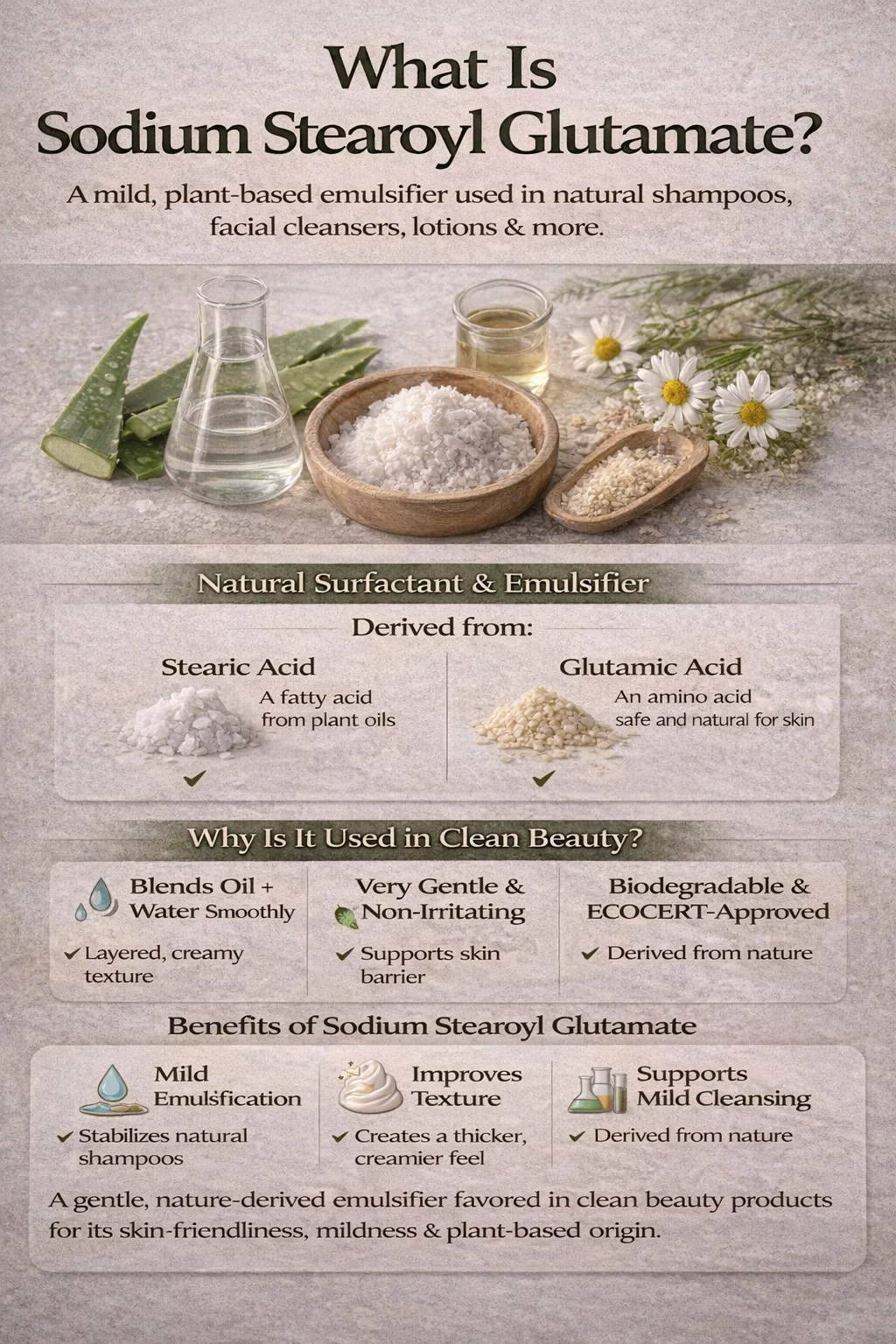
Sodium stearoyl glutamate is a mild emulsifier and surfactant derived from:
- Stearic acid (a fatty acid found naturally in plant oils)
- Glutamic acid (an amino acid naturally found in the skin and hair)
It is classified as an amino-acid–based surfactant/emulsifier, meaning it helps oil- and water-based ingredients blend smoothly without irritating the skin or scalp.
In cosmetics, it is most commonly used to:
- Stabilize emulsions (oil + water)
- Improve texture and creaminess
- Support gentle cleansing systems
- Enhance skin and scalp compatibility
Is Sodium Stearoyl Glutamate Natural?
In clean and natural beauty standards, sodium stearoyl glutamate is considered nature-derived.
- Stearic acid is typically sourced from vegetable oils
- Glutamic acid is produced through fermentation
- The manufacturing process mimics natural biochemical reactions
Because of this, sodium stearoyl glutamate is:
- ECOCERT-approved
- COSMOS-approved
- Accepted in many certified natural and organic formulations
It is not petroleum-derived and is readily biodegradable.
Why Is Sodium Stearoyl Glutamate Used in Personal Care Products?
1. Gentle Emulsification Without Irritation
Many conventional emulsifiers can:
- Strip the skin barrier
- Disrupt the scalp microbiome
- Cause dryness or sensitivity
Sodium stearoyl glutamate is exceptionally mild and:
- Mimics components naturally found in skin
- Supports barrier integrity
- Works well in sensitive-skin formulas
This makes it ideal for daily-use products, including shampoos and facial cleansers.
2. Amino-Acid Compatibility With Skin & Hair
Because it is derived from glutamic acid, an amino acid:
- It aligns closely with the skin’s natural composition
- It helps maintain a healthy skin and scalp pH
- It reduces the risk of irritation compared to synthetic surfactants
This is one reason it appears frequently in baby products, sensitive-skin lines, and dermatology-focused formulations.
3. Improves Texture in Natural Shampoo & Cleansers
Natural shampoos can sometimes feel:
- Thin
- Draggy
- Less creamy than conventional formulas
Sodium stearoyl glutamate helps:
- Create a smoother, creamier texture
- Improve spreadability
- Reduce harsh feel during washing
It does this without silicones or synthetic polymers.
4. Supports Mild Cleansing Systems
While not a primary cleanser on its own, sodium stearoyl glutamate:
- Enhances the mildness of surfactant blends
- Reduces irritation from stronger cleansers
- Helps stabilize sulfate-free formulations
This is especially useful in:
- Sulfate-free shampoos
- Facial cleansers
- Body washes for sensitive skin
Is Sodium Stearoyl Glutamate Safe?
Yes. Sodium stearoyl glutamate has an excellent safety profile.
- Non-toxic
- Non-sensitizing at cosmetic use levels
- Non-comedogenic
- Approved for global cosmetic use
It is widely used in:
- Baby washes
- Facial cleansers
- Moisturizers
- Natural shampoos and conditioners
Sodium Stearoyl Glutamate vs Traditional Emulsifiers
| Feature | Sodium Stearoyl Glutamate | Conventional Emulsifiers |
|---|---|---|
| Source | Plant & amino-acid based | Often synthetic |
| Skin compatibility | Very high | Variable |
| Biodegradability | High | Lower |
| Approved for natural use | Yes | Often no |
| Irritation risk | Very low | Moderate to high |
This comparison explains why natural brands frequently choose sodium stearoyl glutamate despite its higher cost.
Typical Usage Levels
In cosmetic formulations:
- 0.1%–1% for emulsification and stabilization
- Slightly higher in creams and lotions than shampoos
It works best when paired with other mild emulsifiers or surfactants in balanced systems.
Why You’ll See Sodium Stearoyl Glutamate in Clean Beauty
Natural and clean beauty brands face a challenge:
- Avoid harsh emulsifiers
- Maintain stability and shelf life
- Deliver a pleasant user experience
Sodium stearoyl glutamate offers a rare combination of:
- Performance
- Skin compatibility
- Environmental responsibility
That makes it a cornerstone ingredient in modern natural formulation.
Final Takeaway
Sodium stearoyl glutamate is a gentle, amino-acid–based emulsifier that plays a critical role in natural shampoos and skincare products. It supports smooth texture, stable formulations, and excellent skin tolerance—without relying on harsh synthetic chemicals.
When you see sodium stearoyl glutamate on an ingredient label, it generally signals a product designed with skin health, formulation integrity, and clean beauty principles in mind.