What’s the Real Difference?
Walk down any grocery or big-box store aisle and you’ll see shelves packed with brightly colored bottles promising volume, repair, shine, or frizz control. In contrast, natural shampoos often look understated—neutral bottles, shorter ingredient lists, and fewer claims on the label.
So what actually separates natural shampoo from the average store-bought shampoo? The difference goes far beyond marketing. It comes down to formulation philosophy, ingredient function, scalp biology, and long-term hair health.
What Is “Natural Shampoo,” Really?
There is no single legal definition of natural shampoo in the U.S., but most formulations share common principles:
- Ingredients derived primarily from plants, minerals, or naturally occurring compounds
- Minimal use of petrochemicals
- Gentle cleansing agents rather than harsh detergents
- Fewer synthetic fragrances, dyes, and preservatives
- Emphasis on scalp health, not just cosmetic results
Natural shampoos aim to clean without stripping, supporting the scalp’s natural barrier instead of overpowering it.
The Core Difference: Cleansers (Surfactants)
Store-Bought Shampoo Cleansers
Most conventional shampoos rely on strong synthetic surfactants, such as sulfates. These are extremely effective at removing oil, dirt, and product buildup—but they do so aggressively.
Common characteristics:
- High foam and instant “squeaky clean” feel
- Can strip natural oils (sebum) from hair and scalp
- May worsen dryness, irritation, dandruff, or frizz over time
- Often require silicones later in the formula to “replace” slip and shine
This creates a cycle: strip → coat → repeat.
Natural Shampoo Cleansers
Natural shampoos typically use milder surfactants derived from coconut, sugar, or amino acids.
Common characteristics:
- Lower, creamier lather (not foamless, just gentler)
- Cleans without fully removing protective oils
- Better tolerated by sensitive or dry scalps
- Allows the scalp to self-regulate oil production over time
Hair may feel different at first—less slick, more natural—but improves with continued use.
Ingredient List Length & Transparency

Store-Bought Shampoo
- Often 20–40+ ingredients
- Includes synthetic fragrances (often undisclosed blends)
- Uses colorants for visual appeal
- Relies on silicones to mask damage
- Preservatives chosen for cost and shelf life, not skin sensitivity
Many ingredients are not harmful individually—but the cumulative effect can matter, especially for people with eczema, psoriasis, hormonal sensitivity, or fragrance intolerance.
Natural Shampoo
- Shorter, more readable ingredient lists
- Plant oils, hydrosols, botanical extracts
- Naturally derived conditioning agents
- Preservatives selected for low irritation potential
- Fragrance from essential oils or naturally occurring aroma compounds
This transparency makes natural shampoos easier to evaluate—and easier to avoid triggers.
Conditioning: Coating vs. Nourishing
Conventional Conditioners (Inside Shampoo)
- Use silicones to smooth hair instantly
- Create artificial shine by coating the hair shaft
- Can cause buildup that dulls hair over time
- Often require stronger detergents to remove
Natural Conditioning Systems
- Use lightweight plant oils, fatty alcohols, proteins, or glycerin
- Improve flexibility and moisture retention gradually
- Less buildup on scalp and follicles
- Support hair health rather than masking damage
The result is hair that behaves more naturally—sometimes with more texture, but also more resilience.
Scalp Health: The Long Game
Your scalp is skin—and it responds to shampoo the same way facial skin responds to cleanser.
Store-bought shampoos often:
- Disrupt the scalp barrier
- Trigger rebound oil production
- Exacerbate flakes or itching
- Depend on medicated additives to manage symptoms
Natural shampoos aim to:
- Preserve the scalp microbiome
- Reduce inflammation and irritation
- Normalize oil production over time
- Support long-term follicle health
This is why many people experience an adjustment period when switching—your scalp is recalibrating.
Performance Expectations: A Shift in Mindset
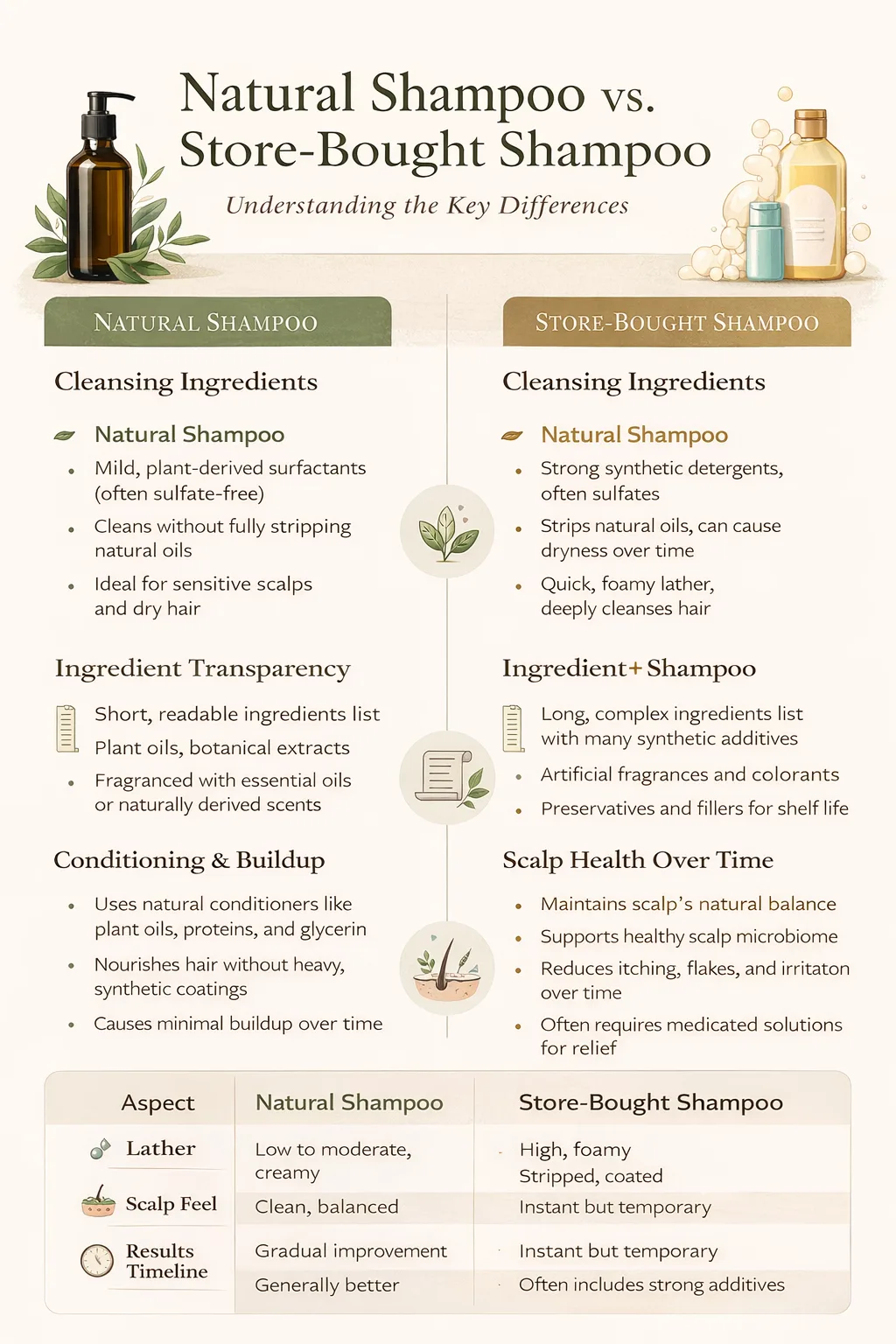
| Aspect | Store-Bought Shampoo | Natural Shampoo |
|---|---|---|
| Lather | High, fast foam | Lower, creamier |
| Feel after wash | Slick, coated | Clean, lightweight |
| Short-term results | Immediate cosmetic impact | Gradual improvement |
| Long-term scalp health | Often compromised | Often improved |
| Sensitivity friendly | Variable | Generally better |
Natural shampoo isn’t about instant perfection—it’s about biological compatibility.
Who Benefits Most from Natural Shampoo?
Natural shampoo tends to work especially well for:
- Sensitive scalps or fragrance intolerance
- Eczema, psoriasis, or chronic scalp irritation
- Curly, wavy, or textured hair
- Children and families
- People reducing overall chemical exposure
Those with heavy styling routines or silicone buildup may need a short detox period before seeing results.
The Bottom Line
Natural shampoos and conventional store-bought shampoos are designed with fundamentally different goals.
- Conventional shampoos prioritize immediate sensory appeal, mass-market consistency, and cosmetic results.
- Natural shampoos prioritize scalp health, ingredient integrity, and long-term hair function.
If you value fewer ingredients, gentler cleansing, and hair that improves over time rather than being cosmetically “managed,” natural shampoo offers a clear and compelling alternative.